| FILM MEDIA AND TELEVISION |
45 |
FILM TELEVISION AND MEDIA ARTS INTERNSHIP AND JOB PREPARATION |
2.0 Units |
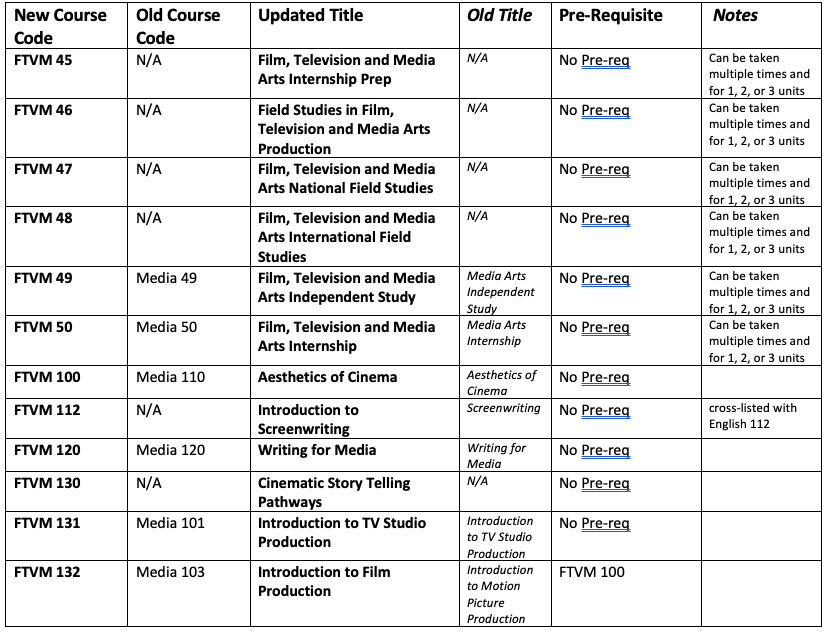
FTVM 45 introduces principles and skills needed to prepare for a career in the Film, TV and Media Arts Industry. It offers hands-on guidance to identify, apply to, and attain an internship or entry level job in the Film, Television, and Media Arts Industry. Note: This course is a Pass/No Pass only. Lecture 1 hour/Laboratory 3 hours. Prerequisite: None. Transfer Credit: CSU |
| FILM MEDIA AND TELEVISION |
46 |
FIELD STUDIES IN FILM TELEVISION AND MEDIA ARTS PRODUCTION |
3.0 Units |
FTVM 46 provides students with hands-on experience in Film, TV and Media Arts production in the field. Students will travel and study in the United States or foreign countries at their own expense. Each course offering will concentrate on a specific target area, chosen for its cultural or social significance. Each student will create an individual project or participate as a member of a production team that relates to each site, under the direction of a Glendale Community College FTVM instructor. Note: This course may be taken 4 times; a maximum of 12 units may be earned. Each repetition must be in a different area of the United States or Internationally. Note: This course is pass/no pass only. Lecture 1.5 hours/Laboratory 4.5 hours. Prerequisite: None. Transfer Credit: CSU |
| FILM MEDIA AND TELEVISION |
47 |
FILM TELEVISION AND MEDIA ARTS NATIONAL FIELD STUDIES |
1.0 to 3.0 Units |
FTVM 47 provides college credit for travel and study in a target area in the United States at the student's own expense in programs provided by agencies approved in advance by the College and under the direction of a Glendale Community College instructor. Note: This course may be taken 4 times; a maximum of 12 units may be earned. Each repetition must be in a different part of the United States/region or a different theme. Note: This course is Pass/No Pass only. Lecture 1-3 hours. Prerequisite: None. Transfer Credit: CSU |
| FILM MEDIA AND TELEVISION |
48 |
FILM TELEVISION AND MEDIA ARTS INTERNATIONAL FIELD STUDIES |
1.0 to 3.0 Units |
FTVM 48 provides college credit for travel and study in foreign countries. Under the direction of a Glendale Community College instructor, students participate in a study abroad program approved by the College. Students are responsible for paying program fees. This course may be offered in other disciplines. Note: This course may be taken 4 times; a maximum of 12 units may be earned. Each repetition must be in a different country and/or area of the world. Note: This course is Pass/No Pass only. Lecture 1-3 hours. Prerequisite: Concurrent registration in 6 or more units. Transfer Credit: CSU |
| FILM MEDIA AND TELEVISION |
49 |
FILM TELEVISION AND MEDIA ARTS INDEPENDENT STUDY |
1.0 to 3.0 Units |
FTVM 49 provides well-qualified students with an opportunity to explore a subject in greater depth than usual, to familiarize students with some basic research techniques, to interest students in possible career areas, and to take advantage of special academic interests. Emphasis shall be on individual research projects, library research and preparation of research papers. There is no prescribed course content. Students develop a research project, have it approved by the sponsoring instructor and appropriate division chairperson, then submit the finished project, which may be library research, or perhaps a supervised experimental program related to a specific course of instruction. Registration is open to any student at GCC who is currently registered for 6 or more units and who is admitted to Independent Study by the instructor. A student is limited to one Independent Study per semester and no more than 12 units credit toward the AA Degree or Certificate, and no more than 6 units per division. The units received may be acceptable for college transfer subject to the approval of the individual college. Note: Independent Study are arranged by faculty in the Visual and Performing Arts Division. This course may be taken 3 times; a maximum of 9 units may be earned. Note: Students who have taken MEDIA 49 may have limited repeats and units. Laboratory 3-9 hours. Corequisite: Concurrent registration in 6 or more units. Transfer Credit: CSU |
| FILM MEDIA AND TELEVISION |
50 |
FILM TELEVISION AND MEDIA ARTS INTERNSHIP |
1.0 to 3.0 Units |
FTVM 50 is a discipline-specific course, which allows students to earn from 1.0 ‚- 3.0 units for a structured, supervised internship either on-campus or off-campus under the supervision of a faculty advisor. It is designed to provide students with appropriate preparation and a hands-on work experience in one of the following fields: Cinema, Television, Digital Media, Screenwriting, or Management. The purpose of this class is to enhance students' knowledge, skill levels, and professional competency in their targeted career. Students must work 60 nonpaid hours or 75 paid hours per unit earned. This course is recommended for the self-motivated student, and requires faculty advisor approval to register. Note: This course is Pass/No Pass only. Note: Students who have taken MEDIA 50 may have limited repeats and units. Laboratory 3-9 hours. Prerequisite or Corequisite: Enrollment in appropriate discipline-specific theory or lab course at GCC. Recommended Preparation: ENGL 100 or ESL 141. Course Typically Offered: Spring. Transfer Credit: CSU |
| FILM MEDIA AND TELEVISION |
100 |
AESTHETICS OF CINEMA |
3.0 Units |
(Previously MEDIA 110) FTVM 100 is the study of the aesthetics and creation of cinematic art. Emphasis is placed on aesthetic concepts as well as the techniques and practices employed to achieve the aesthetic goals of the filmmaker. Specific topics include narrative, visual design, cinematography, editing, sound design, genre, and authorship. The course surveys a wide variety of films, filmmakers, and film movements to explore the diverse possibilities presented by the cinematic art form. Lectures, discussions and readings are supplemented by the screening of representative films. Note: Students who have taken MEDIA 110 may not receive credit for this course. Lecture 3 hours. Recommended Preparation: ENGL 100 or ESL 151. Course Typically Offered: Spring. Transfer Credit: CSU, UC, USC |
| FILM MEDIA AND TELEVISION |
101 |
FILM GENRES |
3.0 Units |
FTVM 101 covers the theory and analysis of classic American film genres such as the Western, the Musical, Film Noir, Horror, Romantic Comedy, Gangster, Sci-fi, Fantasy, War, and Historical Epics. Through lectures, discussion, and film screenings we identify the specific characteristics that define various film genres and how these elements work together. We discuss and evaluate the iconography, aesthetics, themes and archetypes of each genre. At the end of this course, students will be able to identify the elements, themes, topics, tropes, characters, situations, and plot beats that are common in specific genres and their cultural context. Lecture 3 hours. Recommended Preparation: ENGL C1000 or ESL 151, or equivalent. Transfer Credit: CSU, UC |
| FILM MEDIA AND TELEVISION |
102 |
AESTHETICS OF INTERNATIONAL CINEMA: WORLD WAR II TO THE PRESENT |
3.0 Units |
FTVM 102 covers the development of film technology, aesthetics, and genre from World War II to the Present. Students analyze various film movements by their defining narrative, technical, aesthetic, and theoretical contributions to the medium. Topics include Socialist Realism, the development of the Classic Hollywood style, French Impressionism, German Expressionism, Soviet Montage, and the establishment of the Hollywood studio system. We will pay particular attention to the historical, cultural and economic influences that shaped the stylistic shifts of the international art form. Lecture 3 hours. Recommended Preparation: ENGL C1000 or ESL 151, or equivalent. Transfer Credit: CSU, UC |
| FILM MEDIA AND TELEVISION |
103 |
EMERGING GLOBAL CINEMA |
3.0 Units |
FTVM 103 examines contemporary emerging international film movements. Looking outside the boundaries of the Hollywood system, this class analyzes global cinema with a focus on auteur filmmakers who have helped to define their nation's film identity. Students evaluate the films by their defining narrative, technical, aesthetic, and theoretical contributions to the medium, and pay particular attention to cinematic and cultural theories such as transnationalism, global and local cinema, and the caricatures of Asian cultures in film. The course provides critical methodology and practical tools for examining and interpreting the connection between the artist and their work as a reflection of their specific environment. Lecture 3 hours. Recommended Preparation: ENGL C1000 or ESL 151, or equivalent. Transfer Credit: CSU, UC |
| FILM MEDIA AND TELEVISION |
104 |
AMERICAN INDEPENDENT FILM |
3.0 Units |
FTVM 104 covers the history and analysis of Independent U.S. film: low-budget commercial feature films produced, distributed, and/or exhibited outside of mainstream Hollywood. Through screenings and class discussions, students analyze the evolution of Independent Cinema, from the modes of production to the creation of the style and tone of indie" films. Topics include self-distribution film festival circuits and the studio film versus independent. The course introduces students to important films and filmmakers instrumental in the independent genre while comparing and contrasting the aesthetic and content of independent cinema with the traditional practices of Hollywood studios. Lecture 3 hours. Recommended Preparation: ENGL C1000 or ESL 151. Transfer Credit: CSU, UC |
| FILM MEDIA AND TELEVISION |
106 |
GREAT FILMMAKERS |
3.0 Units |
FTVM 106 focuses on the careers of significant auteur filmmakers (directors) and analyzes their filmography in aesthetic, thematic, ideological, geographical, artistic, social, political and historical terms. This course reviews a director's or a collection of directors' work (instructor's choice) highlighting their specific visual and narrative styles and thematic preoccupations. Students will articulate specific insights of the director's/directors' work through various writing and creative projects. Lecture 3 hours. Recommended Preparation: ENGL C1000 or ESL 151, or equivalent. Transfer Credit: CSU, UC |
| FILM MEDIA AND TELEVISION |
107 |
BEYOND HOLLYWOOD: GENDER RACE AND SEX IN MOVIES |
3.0 Units |
FTVM 107 examines the intersections of gender, race, class and sexuality in U.S. and/or international film using critical and historical perspectives and surveys the economic, historical, and social influences upon these representations from early cinema to the present, focusing primarily on images of women. Students explore women's filmmaking, images of masculinity, and various‚ screen sexualities from a variety of film theories and analytical perspectives. Lecture 3 hours. Recommended Preparation: ENGL C1000 or ESL 151 or equivalent. Transfer Credit: CSU, UC |
| FILM MEDIA AND TELEVISION |
108 |
DOCUMENTARY FILM AESTHETICS |
3.0 Units |
FTVM 108 explores how the style, look, and structure of documentary films affect considerations of ethics, point of view, and persuasion. Topics of study include the voice of documentary, documentary modes, the influence of social media, cultural and national representation in documentary, and the evolution of digital technology in the context of nonfiction. Students will watch a wide variety of documentaries that examine the concept of ‚"truth" on film and the filmmaker's ability to distort or clarify our perception of reality. We will pay particular attention to the historical, cultural, environmental, political and economic influences that shaped the documentary form. Lecture 3 hours. Recommended Preparation: ENGL C1000 or ESL 151, or equivalent. Transfer Credit: CSU, UC |
| FILM MEDIA AND TELEVISION |
112 |
INTRODUCTION TO SCREENWRITING |
3.0 Units |
FTVM 112 is a basic introductory course in narrative script writing for film and episodic television. Emphasis is placed upon the essentials of screenplay structure, characters, conflict, theme, and technical script formatting in the development of a short screenplay. Note: This course may not be taken for credit by students who have completed ENGL 112. Lecture 3 hours. Recommended Preparation: ENGL C1000 or ESL 151, or equivalent. Transfer Credit: CSU, UC |
| FILM MEDIA AND TELEVISION |
120 |
WRITING FOR MEDIA |
3.0 Units |
FTVM 120 offers an introduction to writing for film, television, radio and electronic media. The course focuses on preparing scripts in proper formats, including fundamental technical, conceptual and stylistic issues related to writing fiction and non-fiction scripts for informational and entertainment purposes in film and electronic media. The course includes a writing evaluation component as a significant part of the course requirement. Note: Students who have taken MEDIA 120 may not receive credit for this course. Lecture 3 hours. Recommended Preparation: ENGL C1000 or ESL 151, or equivalent. Transfer Credit: CSU, UC, USC |
| FILM MEDIA AND TELEVISION |
130 |
CINEMATIC STORYTELLING PATHWAYS |
2.0 Units |
FTVM 130 is an introductory course covering both the critical appreciation of cinema and the basic techniques of digital filmmaking, while emphasizing students' personal and creative expression. This course also introduces students to the career pathways to film and television including the roles and responsibilities of the departments of a production crew. Topics include the theory and practice of visualization, the grammar of cinematic storytelling, the aesthetics of various film movements, camera technique, lighting, sound recording, sound design, directing, and other fundamentals related to learning the craft and art of digital filmmaking. Students engage in critical appreciation through individual and group analysis of movies and episodic television, as well as in filming cinematic exercises under the supervision of their instructor. Note: A material/lab fee may be required for this course. Lecture 1 hour/Laboratory 3 hours. Prerequisite: None. Transfer Credit: CSU, UC |
| FILM MEDIA AND TELEVISION |
131 |
INTRODUCTION TO TV STUDIO PRODUCTION |
3.0 Units |
(Previously MEDIA 101) FTVM 131 provides students with a basic overview of the aesthetics and techniques required in the production of studio based multiple camera video programs. The topics include studio and control room operations, directing, crew responsibilities, operation of video and audio equipment, lighting, video graphics and sound mixing. Projects consist of hands-on experiences in several live" video studio production situations performed in the Glendale College Television Studio (GCTV Studio.) Note: Students who have taken MEDIA 101 may not receive credit for this course. Note: A material/lab fee may be required for this course. Lecture 1.5 hours/Laboratory 4.5 hours. Prerequisite: None. Course Typically Offered: Fall/Spring. Transfer Credit: CSU, UC |
| FILM MEDIA AND TELEVISION |
132 |
INTRODUCTION TO FILM PRODUCTION |
3.0 Units |
(Previously MEDIA 103) FTVM 132 provides students with a basic overview of the aesthetics and techniques required to cinematically tell a story via single-camera motion picture production. Topics include basic cinematography, camera familiarization and operation, lenses, camera angles, camera blocking and movement, coverage, continuity, digital recording formats, filters, location production, lighting and simple editing. Projects consist of hands-on experiences working in a production team with digital cinema cameras and editing workstations. Note: Students who have taken MEDIA 103 may not receive credit for this course. Note: A material/lab fee may be required for this course. Lecture 1.5 hours/Laboratory 4.5 hours. Prerequisite: FTVM 130. Course Typically Offered: Winter/Spring/Summer/Fall. Transfer Credit: CSU, UC, USC. (C-ID FTVE 150) |
| FILM MEDIA AND TELEVISION |
135 |
INTRODUCTION TO AUDIO PRODUCTION |
3.0 Units |
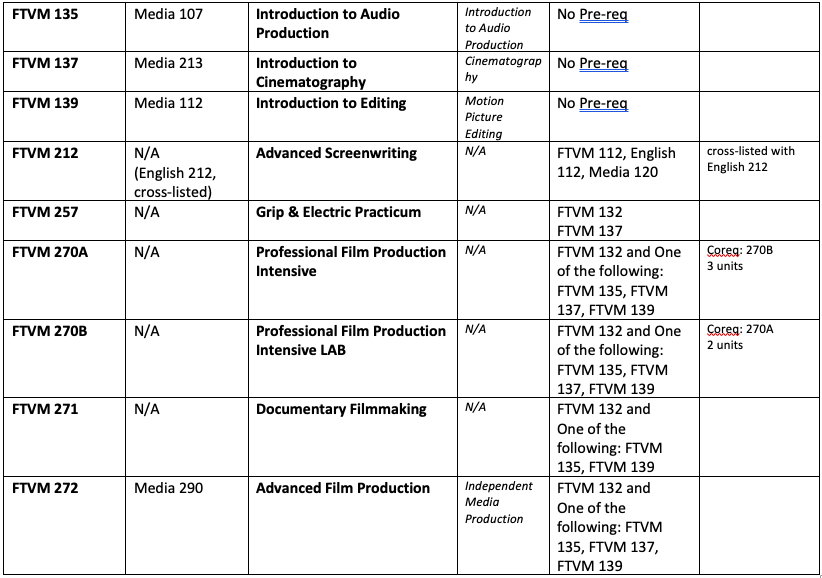
(Previously MEDIA 107) FTVM 135 teaches students the basic principles, aesthetics, and techniques required in the production of audio programs and soundtracks for video programs. Specific topics include digital recording and editing, selection and use of microphones, sound studio operation, multi-tracking, equalization, compression, mixing, editing, and synchronization with video. Industry standard software such as Pro Tools will be utilized. Hands-on practice with professional equipment is emphasized. Note: Students who have taken MEDIA 107 may not receive credit for this course. Note: A material/lab fee may be required for this course. Lecture 1.5 hours/Laboratory 4.5 hours. Prerequisite: None. Course Typically Offered: Fall/Spring. Transfer Credit: CSU, UC, USC |
| FILM MEDIA AND TELEVISION |
137 |
INTRODUCTION TO CINEMATOGRAPHY |
3.0 Units |
(Previously MEDIA 213) FTVM 137 is an entry level exploration of the art and craft of cinematography. In this hands-on course, students will delve into the art and craft of cinematography: the methods and techniques by which cinematic composition and lighting give a film meaning and aesthetic purpose. Through lectures, demonstrations, exercises in a supervised classroom environment, and individual assignments in the field, students will learn to operate state-of-the-art digital and electronic equipment while applying the fundamental principles of lighting, composition, exposure, focus, lens selection, and camera dynamics into purposeful visual storytelling. Note: Students who have taken MEDIA 213 may not receive credit for this course. Note: A material/lab fee may be required for this course. Lecture 1.5 hours/Laboratory 4.5 hours. Prerequisite: None. Course Typically Offered: Fall/Spring. Transfer Credit: CSU, UC, USC |
| FILM MEDIA AND TELEVISION |
139 |
INTRODUCTION TO EDITING |
3.0 Units |
(Previously MEDIA 112) FTVM 139 is an intermediate-level media production class. Emphasis is on editing techniques and aesthetics for motion picture productions using professional applications. Topics include system set-up, footage importing, append and insert editing, dialog and multi-clip editing, media management, pace, continuity, format workflow, effects, titling and compression. Students output their projects to professional-level deliverable digital video files. Note: Students who have taken MEDIA 112 may not receive credit for this course. Lecture 1.5 hours/Laboratory 4.5 hours. Prerequisite: None. Course Typically Offered: Fall/Spring. Transfer Credit: CSU |
| FILM MEDIA AND TELEVISION |
212 |
ADVANCED SCREENWRITING |
3.0 Units |
FTVM 212 is an advanced course in narrative script writing for film. Emphasis is placed on character creation, story development, and three act structure. Students will develop story scenarios, choose one to outline as a feature film, and write Act One in screenplay format. Note: This course may not be taken for credit by students who have completed ENGL 212. Lecture 3 hours. Prerequisite: FTVM 112, ENGL 112, or FTVM 120. Transfer Credit: CSU, UC |
| FILM MEDIA AND TELEVISION |
249 |
ADVANCED EDITING |
3.0 Units |
FTVM 249 builds on skills learned in FTVM 139, Introduction to Editing. Students practice video editing and understanding of professional production and post-production workflows as related to processes, storytelling, formats, visual effects and hardware. This course also uses industry-standard Avid Media Composer software to prepare students to take the Media Composer 101 and 110 exams that lead to an Avid User certificate. Lecture 1.5 hours/Laboratory 4.5 hours. Prerequisite: FTVM 139. Transfer Credit: CSU, UC |
| FILM MEDIA AND TELEVISION |
255 |
FIELD SOUND PRODUCTION PRACTICUM |
1.0 Unit |
FTVM 255 offers professional training in the techniques and craft used by Sound Recordist in the field while working as key members of a professional motion picture production. Laboratory 3 hours. Prerequisite: FTVM 132 and FTVM 135. Transfer Credit: CSU |
| FILM MEDIA AND TELEVISION |
256 |
POST PRODUCTION SOUND PRACTICUM |
1.0 Unit |
FTVM 256 offers professional training in the techniques and craft used by Post Production Audio Team in the studio while working as key members of a professional Post Production Sound Design and Edit Team. Laboratory 3 hours. Prerequisite: None. Transfer Credit: CSU |
| FILM MEDIA AND TELEVISION |
257 |
GRIP AND LIGHTING PRACTICUM |
1.0 Unit |
FTVM 257 offers professional training in the techniques and craft used by Grips and Lighting Technicians working as key members of a professional motion picture production. Laboratory 3 hours. Prerequisite: FTVM 132 and FTVM 137. Transfer Credit: CSU |
| FILM MEDIA AND TELEVISION |
258 |
CAMERA ASSISTANT PRACTICUM |
1.0 Unit |
FTVM 258 offers professional training in the techniques and craft of a Camera Assistant working as a key member of a camera department on a professional motion picture production. Laboratory 3 hours. Prerequisite: FTVM 132 and FTVM 137. Transfer Credit: CSU |
| FILM MEDIA AND TELEVISION |
259 |
ASSISTANT EDITOR PRACTICUM |
1.0 Unit |
FTVM 259 offers professional training in the techniques and craft used by an assistant editor while assisting an editor in the post production house. Laboratory 3 hours. Prerequisite: FTVM 132 and FTVM 139. Transfer Credit: CSU |
| FILM MEDIA AND TELEVISION |
271 |
DOCUMENTARY FILMMAKING |
3.0 Units |
FTVM 271 is a documentary filmmaking production course in which students work on a project from concept to distribution. Students practice fundamental skills including documentary producing, sound recording, lighting, cinematography and editing in the context of historical movements, contemporary issues, and diverse perspectives. Note: A material/lab fee may be required for this course. Lecture 1.5 hours/Laboratory 4.5 hours. Prerequisite: FTVM 130, 132, 135, 137, 139, or 46. Transfer Credit: CSU, UC |
| FILM MEDIA AND TELEVISION |
272 |
ADVANCED FILM PRODUCTION |
2.0 Units |
FTVM 272 is designed to provide a realistic working experience in film and media production. The emphasis is on individual production of short films and media segments in order to build a personal portfolio or demo reel of production work. Students have regular access to professional film and media equipment and gain experience with all capabilities of the Media Arts studio. Students may also create independent media productions for the campus and community. Note: Students who have taken MEDIA 290 may have limited repeats and units. Note: A material/lab fee may be required for this course. Laboratory 6 hours. Prerequisite: FTVM 132 or equivalent. Course Typically Offered: Fall/Spring. Transfer Credit: CSU |
| FILM MEDIA AND TELEVISION |
270A |
PROFESSIONAL FILM PRODUCTION INTENSIVE |
3.0 Units |
FTVM 270A is a fast paced, hands-on course, in which students go through the process of developing, pre-producing and shooting a film together, as a crew, emulating a professional working environment. Supervised by their instructor and industry professionals on and off set, students develop, pre-produce, rehearse, shoot, and edit scenes from an original screenplay that is filmed in its entirety - on location - at the end of the semester. Lecture 1.5 hours/Laboratory 4.5 hours. Prerequisite: FTVM 132 and FTVM 135, FTVM 137, or FTVM 139. Corequisite: FTVM 270B. Transfer Credit: CSU, UC |
| FILM MEDIA AND TELEVISION |
270B |
PROFESSIONAL FILM PRODUCTION INTENSIVE LABORATORY |
1.0 to 2.0 Units |
FTVM 270B is a fast paced, hands-on course, in which students, industry professionals and faculty shoot on location as part of the lab component of FTVM 270A. Students go through the process of developing, pre-producing and shooting a film together, as a crew, emulating a professional working environment. Supervised by their instructor and industry professionals on set, students shoot the original screenplay that is pre-produced in FTVM 270A Professional Film Production Intensive. The shoot hours are determined by the needs of the film and may take place off-campus. Laboratory 3.0-6.0 hours. Corequisite: FTVM 270A. Transfer Credit: CSU |