CALIFORNIA STATE UNIVERSITY (CSU)


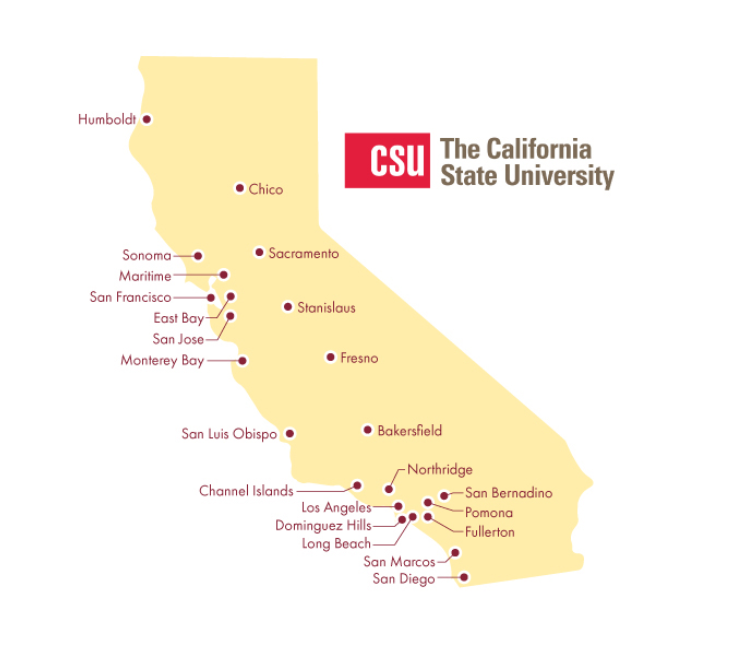
The California State University (CSU) system is made up of 22* undergraduate campuses with a focus on practical and professional training to prepare graduates to enter the job market. Curriculum includes some theory and research.

*Cal Poly San Luis Obispo and California State University, Maritime Academy are being integrated. Effective July 1, 2025, the two institutions will operate as a single university, Cal Poly.

To transfer as a junior (also known as an upper-division transfer), you must complete the following requirements by the end of the spring term prior to fall enrollment at a CSU:

  • 60 CSU-transferable units
  • 2.0 GPA in CSU-transferable coursework
  • 30 units of general education
    • Including the Golden 4
  • Good academic standing

60 CSU-Transferable Units

You can confirm which courses are CSU-transferable in the GCC Catalog or at assist.org.

2.0 GPA

This GPA includes only CSU-transferable courses and is the minimum required to be considered for admission. Many campuses and majors require a higher GPA for admission selection.

General Education

At least 30 of the 60 units should be general education courses. To fulfill your general education requirements, you can follow the Cal-GETC requirements. If you attended GCC continuously before Fall 2025, you also have the option to follow the IGETC or CSU GE Breadth requirements.

Golden 4

The 30 units of general education should include these four courses:

  • One course in English Composition (ENGL C1000, C1000E, or C1000H)
  • One course in Critical Thinking (listed in Area 1B of Cal-GETC/IGETC and Area A3 of CSU GE Breadth)
  • One course in Oral Communication (listed in Area 1C of Cal-GETC/IGETC and Area A1 of CSU GE Breadth)
  • One course in Mathematical Concepts and Quantitative Reasoning (listed in Area 2 of Cal-GETC/IGETC and Area B4 of CSU GE Breadth)

Good Academic Standing

Students must be in good standing (eligible to re-enroll) at the last college or university attended.

Some CSU campuses are impacted or have impacted majors. Impaction means there are more applicants to a campus or major than there are spaces available. If impacted, campuses are allowed to use additional criteria to screen applications, including requiring specific courses (see below), a higher GPA, and submitting your application during the priority filing period. Impacted campuses have also established local admission areas, and generally, students from outside the local area will be held to higher admission requirements than those received from students inside the local area.

campus  impaction  major requirements & transfer resources
 CSU Fullerton Transfer Impaction Major Impaction
 CSU Los Angeles Transfer Admission Eligibility Major-Specific Criteria
 CSU Long Beach Transfer Admission Eligibility Major-Specific Degree Requirements for Transfer Students
 CSU Northridge Transfer Admission Eligibility Impacted Majors
 Cal Poly Pomona Transfer Admission Eligibility Impacted Majors
 Cal Poly San Luis Obispo Selection Criteria for Transfer Students Major Specific Transfer Criteria
 San Diego State University Transfer Admission Eligibility SDSU Catalog
Transferology
Minimum GPA Requirements
 San Jose State University Impaction Criteria for Transfers Program Specific Coursework

To see which GCC courses fulfill the above requirements for a specific campus and major, check assist.org.

Note: Impaction and major requirements may change from year to year. It is always recommended to check in with a GCC counselor to ensure you are meeting the minimum requirements for admission.

GCC currently offers several Associate Degrees for Transfer. These include Associate in Arts (AA-T) and Associate in Science (AS-T) degrees.

These degrees are designed to provide a clear pathway to a CSU major and a bachelor's degree. California Community College students who are awarded an ADT are guaranteed admission with junior standing to one of the CSUs, though not necessarily to a particular campus or major. Also, students are given priority admission consideration to their local CSU campus or to a program that is deemed similar to their ADT major. Students who have been awarded an AA-T or AS-T degree are able to complete their remaining requirements for the bachelor's degree within 60 semester units.

Note: The ADT may not be the best option for everyone. It's best to talk to a counselor about where you want to transfer and with what major; they can help you decide if the ADT is right for you.

The following is required for all AA-T/AS-T degrees:

  • 60 CSU-transferable semester units
  • Minimum of 2.0 GPA in all CSU-transferable coursework
  • Certified completion of Cal-GETC
  • Completion of a minimum of 18 semester units in an AA-T/AS-T major
    • All courses in the major must be completed with a grade of “C” or better or a “P” if the course is taken on a “Pass/No Pass" basis

Students entering a California Community College for the first time can get guaranteed admission to a CSU through the Transfer Success Pathway (TSP) program.

To be eligible for the TSP program, students must meet the following criteria:

  • First-time freshman who either:
    • Wasn’t eligible to attend the CSU at the time they graduated from high school; Or
    • Didn’t attend a CSU because of personal or financial reasons
  • Graduated high school in 2025 or prior, and did not receive any college credit after high school graduation

Eligible students can apply to the program to:

  • Enter into an agreement with the CSU and receive guaranteed admission to the degree program and campus of your choice. Please note:
    • All TSP requirements must be met within three years
    • Available degree programs vary by each CSU
  • Receive personalized guidance from CSU representatives to create an educational plan that will help you transfer in three years or less.
  • Map out your coursework using the CSU Transfer Planner portal to ensure you’re on track to earning your degree.

To learn more about the TSP program and how to apply, visit the Transfer Success Pathway website.

Fall Admission

AUGUST 1: Application opens. Beginning with the Fall 2027 admission cycle.

OCTOBER 1–NOVEMBER 30: Application filing period. The Fall 2026 deadline is December 1, 2025.

JANUARY: Some CSUs, like CSULB and SJSU, require supplemental applications to be submitted. Some CSUs may request official transcripts or may require an application update for applicants to report final fall grades and in progress or planned coursework.

The deadline to submit official transcripts and/or official AP/IB/CLEP exam scores varies from campus to campus, so make sure to regularly check your email and CSU campus portal. Students can be denied admission for missing deadlines.

OCTOBER 1-MARCH 2: Priority application filing deadline for financial aid. Students should fill out the Free Application for Federal Student Aid (FAFSA) or CA Dream Act Application (CADAA), depending on eligibility. GCC submits your GCC GPA to Cal Grant automatically; therefore, there is no need for the Cal Grant GPA Verification Form if GCC was your only college of attendance. 

JANUARY-APRIL: Admission decisions released.

FEBRUARY-MARCH: Meet with a counselor to apply for any associate degrees you qualify for, including the Associate Degree for Transfer (ADT). If you are completing the Cal-GETC, IGETC, or CSU GE Breadth requirements, you should also apply for the Cal-GETC, IGETC, or CSU Breadth certificate. 

MAY 1: Deadline for admitted students to submit an Intent to Register and/or an Enrollment Confirmation Deposit (ECD) for most CSUs. 

JULY: Final, official transcripts and test scores (if applicable) must be submitted to the CSU campus admissions office. Most schools request Cal-GETC, IGETC, or CSU GE Breadth certification during this time. If you have not already done so, apply for GE certification. You can request GE certification when ordering your transcript through Admissions & Records.

Spring Admission 

JULY 1–AUGUST 31: Application filing period for some CSU campuses. Beginning with the Spring 2027 admission cycle. In future spring cycles, the application filing period will be July 1-July 31.

AUGUST-OCTOBER: Admission decisions released.

SEPTEMBER: Some CSUs, like CSULB and SJSU, require supplemental applications to be submitted.

The deadline to submit official transcripts and/or official AP/IB/CLEP exam scores varies from campus to campus, so make sure to regularly check your email and CSU campus portal. Students can be denied admission for missing deadlines.

SEPTEMBER-OCTOBER: Meet with a counselor to apply for any associate degrees you qualify for, including the Associate Degree for Transfer (ADT). If you are completing the Cal-GETC, IGETC, or CSU GE Breadth requirements, you should also apply for the Cal-GETC, IGETC, or CSU Breadth certificate. 

NOVEMBER: Deadline for admitted students to submit an Intent to Register and/or an Enrollment Confirmation Deposit (ECD) for most CSUs.

CSU APPLICATION

The CSU application fee is $70 per campus*.

*If you qualify for a fee waiver, you can apply to up to 4 campuses for free!

Application Resources

Application Tips

  • Remember that you need to meet all admission requirements, including 60 transferable units, by the end of the spring term prior to transfer. Do not assume you can take courses in the summer before transfer, and have those courses "make up" for courses you didn't previously complete. Please contact each CSU campus directly about their policies regarding summer course completion.
  • Obtain unofficial transcripts for all colleges attended and AP/IB/CLEP scores (if applicable).
  • The CSU application requires you to enter all courses you have taken, including non-transferable courses.  Input courses exactly as they appear on your transcript, including those in which you received "F," "D," "W," "EW," "I," and "NP" grades. 

  • If you see the "07 - Academic Renewal" code in your course history, you should report this grade as "AR."

  • If you repeated a course in which you received a "D" or "F" for a better grade and have the "05 - Course Repeated Excluded" code in your course history, you should report this grade as "RP."

  • You will also need to indicate what courses you plan to take for the remainder of your time at GCC. If you are unsure, meet with a counselor to map out what courses remain for your intended goal.

  • Identify the courses you are using to fulfill the Golden Four requirements: Oral Communication, English Composition, Critical Thinking, and Math/Quantitative Reasoning.
  • When you apply for admission through Cal State Apply, you are automatically considered for an application fee waiver based on the information requested in the application. Applicants who are eligible for the application fee waiver may apply to up to four CSU campuses per application term (i.e., fall, spring).
  • The CSU application does not require the completion of essays or personal statements.
  • Check the application to make sure you entered all the information correctly. If there are errors or omissions, notify the campuses that you applied to immediately.
  • You do not need to send transcripts or GE certification at the time of your application. You only send transcripts when they are requested by the CSU campus. Campuses may have different deadlines. Check your email and CSU campus portal(s) for deadlines. 
  • Activate your campus student portal(s) as soon as possible. In addition to email, the campus portal is one of the primary means that campuses use to communicate with students regarding important updates, such as your application status and required document deadlines.

  • Follow all deadlines and submit any required documents to ensure your application continues to be processed (e.g., official transcripts, exam scores).
  • If you have college or university courses (other than GCC) or AP/IB/CLEP credit that you are using to satisfy CSU GE Breadth, IGETC, or Cal-GETC requirements, or elective units for transfer, they must be evaluated to determine transferability and applicability to specific requirements. If you haven't done so, please see a GCC counselor to start that process.

Transfer Application Update

  • After applying to the CSU, transfer applicants should update their academic history in Cal State Apply by January 31st to ensure the CSUs have your most recent grades and courses.
  • To complete the application update, you need to log in to your Cal State Apply account and go to the Academic History quadrant of the application. Here you will provide your fall grades and confirm or update your upcoming winter/spring/summer schedules.
  • If you repeated a course or received academic renewal, you can update these grades in the appropriate terms.
  • Even if you didn't pass a class or earned a "W" in the fall, you must include it on the application update.
  • Winter intersession grades are not included in the GPA calculation for admission. Students should not wait for winter grades before submitting the application update, as those grades are typically not available before the January 31st deadline. 

In addition to completing the Cal State Apply Academic Update, some CSU campuses may request that you complete a supplemental application. Make sure that you complete both, as the campuses using the supplemental applications will likely deny admission if they are not submitted by the deadline.

Application Help Center

Cal State Apply Applicant Help Center & Resources

Cal State Apply Support Team

  • Applicant Support Email: calstateapply@liaisoncas.com
  • Applicant Support Phone: 857-304-2087
  • Applicant Support Chat: Live Chat support located in Help Center