Día de Muertos Flyer

Join us for our 6th Annual Día de los Muertos at Glendale Community College!

Día de los Muertos, is a Mexican holiday, is when families welcome back the spirits of their departed loved ones for a brief reunion involving food, drink, and celebration. The celebration is observed every year from October 31 to November 2.


  Painting Activities
Vaquero Plaza from 11:30am-1:30pm

Calaveras during Dia de los Muertos represent those who have passed and are often found on the altar as a sugar skull. In some indigenous traditions, the skulls of the deceased were preserved to be placed on the altar and others wore masks as a closing ceremony sending the spirits back. The altar as well as the skulls placed on them, hold different colors that represent different elements, journeys, and cardinal points.


Día de los Muertos Discussion

Presenter: Dr. Wendy Fonarow 
12:30pm-1:30pm 
San Rafael (SR) 138

Biography: Wendy Fonarow, PhD, is a professor of Cultural Anthropology. She is the Chair of the Anthropology Department. In addition to teaching at Glendale, she has been a visiting Associate Professor at UCLA and CSUN and given guest lectures nationally and internationally. Her research areas are ritual, performance, live music, audiences, and the music industry. Her masters focused on Halloween and her current work extends to other autumnal holidays including Thanksgiving, Guy Fawkes, and Dias de Los Muertos. Her latest work is examining cross-cultural attitudes towards the dead. In 2018, she received the Senate Innovation Grant for coordinated research on Halloween and related international celebrations and in 2020 the Senate Grant for the Dias de Los Muertos display in the Sierra Vista building. Her recent How to Do Fieldwork in the Music Industry is available for use in Cultural Anthropology courses as an Open Educational Resource. 


MEXHICA TRIBU-QUETZALLY PERFORMANCE

1:45pm-2:30pm in Vaquero Plaza

Aztec Fire Dancers is named such because of Aztec (Mexicah) traditions come from the neighborhood of Tlacopan (today known as Tacuba) in Mexico City. Faculty and staff will witness the tradition of “Aztec Dancing” or La Danza Azteca from the dancers’ hometown Tlacopan (Tacuba) and its importance in Aztec (Mexicah) ceremonies throughout Mexico today. Faculty and staff will be able to witness the dances that represent the timeless splendor of the Mexicah culture. Through these dances, Mexicah ancestors and the indigenous legacy are honored and the conservation of historical and cultural Mexicah identities. The splendor of the Aztec (Mexicah) peoples is alive and well and not an imagination from the past.

ALL EVENTS AND ACTIVITIES ARE FREE AND OPEN TO THE COMMUNITY

These programs are brought to you by the Multicultural and Community Engagement Center, Cultural Diversity, and sponsored by Student Equity and Achievement

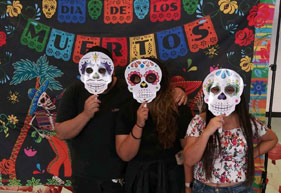
Dia de los muertos, masks on 2019

Día de los Muertos

Día De Los Muertos is a day of observance to acknowledge death as a part of life and celebrate those who have passed. It is a day to welcome the spirits of loved ones as honored guests. This is a family-centered day where the spirits visit the living and the living celebrate them in remembrance. This is a contrast from the European and American individualistic attitude of death and personal identity, where death is often viewed as something to fear or as an end (Marchi, 2009). The worldview of many Indigenous communities in Mexico and Latin American countries is very community-focused and hold a collective attitude. Historically, and culturally, this has been crucial to the physical and psychological survival of these communities and this day of observance demonstrates that value of community (Marchi, 2009). 

At the center of Día De Los Muertos, are offrendas, or offerings that families create in their homes or over the loved one’s graves (Marchi, 2009). These “home shrines” may include the loved one’s favorite drinks and food, candles, and personal mementos of the dead (Marchi, 2009). Papel picado or cut tissue paper, calaveras de azucar or sugar skulls, pan de muerto or bread of the dead, incense, tamales, fruit, nuts, and candies can be seen throughout altars or in the offerings. On the day that the angelitos or little angels, are celebrated, the child’s favorite dish may be made. Candies and decorations of toys will also be evident. On the day that adult souls are celebrated, the food, altars and beverages change in their remembrance (Hocker et. al., 2005). There is even a day to celebrate our pet’s souls. 

Although predominant in Mexico, this special day is also celebrated across many countries including those of Ecuador, Guatemala, Bolivia, Haiti, and Peru to name a few (Hocker et. al., 2005). Día De Los Muertos is celebrated on November 1st, and ends on November 2nd. However, the ofrendas, or offerings, are put out in remembrance as early as October 25th (Marchi, 2009). The spirits of the children are expected to arrive before adults on October 31st while adult souls arrive on November 1st (Hocker et. al., 2005). On November 2nd, families take part of the food to the cemeteries, graves are decorated with cempasúchil or marigold flowers, coxcomb flowers, and white gladioli flowers. The vigils can last all night (Hocker et. al., 2005). The tradition carries on to the dawn, where then, the dead return to their world.  It is important to note that although traditionally recognized in Mexico, each country has their own cultural way of celebrating. This can be noticed in the types of food, offerings, and even the beginning days of celebration. It may even vary be region to region. (Marchi, 2009). Nonetheless, all of these traditions demonstrate how life is and death are a cycle of life, both to be celebrated and not feared. 
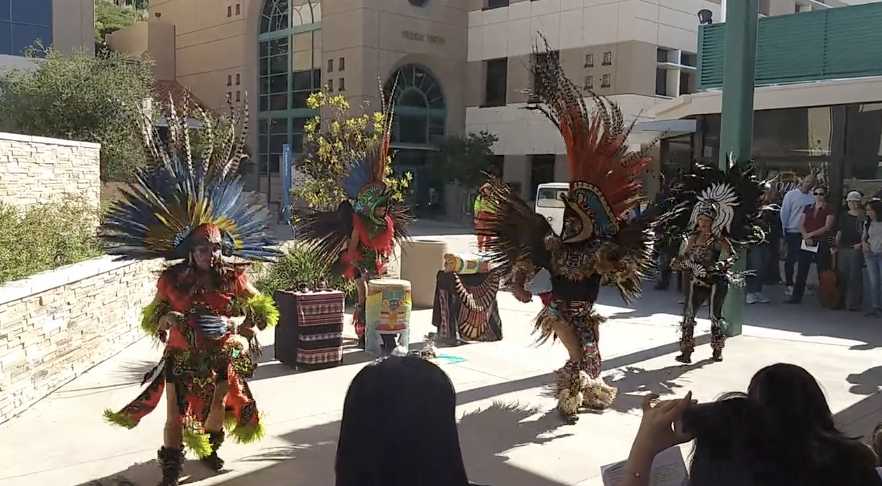
Three Aztec Dancers dancing at the GCC campus in celebration of Dia de los Muertos

Background and History 

The celebration of the dead and the traditions between both worlds can be traced back to the days of the Aztecs, Maya, Mixtec, Aymara, and Quecha (Marchi, 2009). There is evidence that indigenous cultures of pre-Hispanic Mexico, recorded these practices through hieroglyphs picture, and symbols (Marchi, 2009).  These traditions were core beliefs long before the arrival of Europeans to the Americas, and before the Spanish invaded Mexico. Fast forward to today, Día De Los Muertos is a fusion of indigenous and Roman Catholic rituals honoring the dead (Marchi, 2009). This Roman Catholicism invasion in Mexico pushed an effort to eradicate all indigenous traditions and culture. However, the Catholic Missionaries found it difficult to eradicate all practices including the ones of honoring the dead (Marchi, 2009). The Roman Catholic All Saints Day consisted of viewing death as a time of suffering, a need to free the souls, and some celebratory events for the saints that were celebrated on November 1st and 2nd; a perspective different than the indigenous people. (Marchi, 2009). 

 As a result of their failed eradication in this practice, Roman Catholic liturgical relocated their efforts to fuse the celebration of Indigenous customs honoring the dead, with Catholicism’s specific dates of “All Saints’ Day” and their “All Souls Day” (Marchi, 2009). It is why Día De Los Muertos falls on these days today. The result is the mixture of indigenous practices that emphasize death as an important part of life, as well as Catholic practices. A beautiful indigenous practice while also, deeply enwoven, the evidence of exploitation and eradication of people.  

Today, many of these practices to honor the dead, remain the same. The practices, the values of family, and death as a part of life are evident throughout Mexico and Latin American practices. The holiday here in the United States holds very similar traditions with a few differences. Again, this is diverse region by region. In the United States. Some of the reasons that here in the United States the practices of Día De Los Muertos may not include all indigenous practices are: the pressure that many Mexican Americans and Latino Americans have faced to assimilate to Anglo-cultural norms, not visiting graves on November 2nd because many migrants do not have relatives buried nearby, and the for profit practices evident in the United States to make money out of Día De Los Muertos (Marchi, 2009).  

Remembering the dead and celebrating them is something sacred for many who celebrate Día De Los Muertos. There is a core value placed on community and culture. Regardless of the region or way practiced, Día De Los Muertos is growing in the United States and has created an awareness of this special day.  It is a reminder that our loved ones who have passed away are present in spirit and in our memories. That is something worthy to celebrate. 

Curated by Fidel Gonzalez, Adjunct Counselor for Student Equity

Sources 

Hocker, B. Orantes, E., Henry, B., Davidman, R., Nelson, Karen. (2005). Días De Los Muertos  Curriculum Packet. Oakland Museum of California. 

Marchi, R. M. (2009). Day of the Dead in the USA : The Migration and Transformation of a  Cultural Phenomenon. Rutgers University Press. 
  • Altar - a shrine dedicated to the passing of the loved ones. Decorated with food, pictures, flowers, and more. Found in homes or graves.

  • Angelitos - the souls of the children who have died; literally "little angels" 

  • Calacas - skull figures that represent death 

  • Calaveritas de azúcar - sugar skulls made for the Día de los Muertos 

  • Cempazuchitl - a yellow marigold, the symbol of death, also known as cempasuchil or zempasuchitl 

  • Día de los Muertos - Day of the Dead 

  • Ofrenda - an offering; refers to the goods set out on the altars 

  • Pan de los muertos - bread of the dead 

  • Papel picado - colorful tissue paper with intricate, festive designs cut out

  • Ritual - a form or system of solemn ceremonies

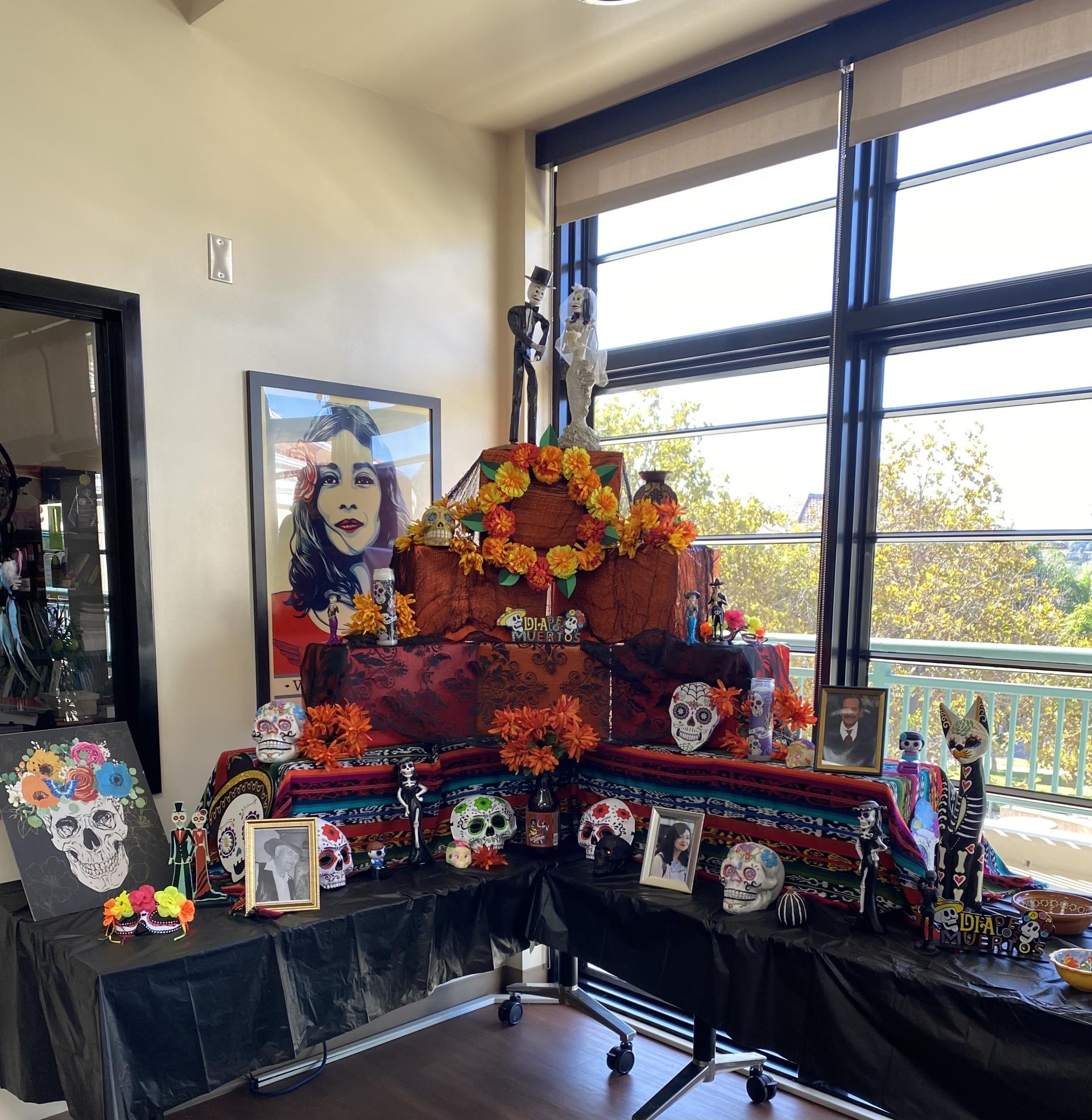
Altar in the Multicultural Center Fall 2021

What is an Altar or Ofrenda?

The centerpiece of the celebration is an altar, or ofrenda, built in private homes and cemeteries. These aren’t altars for worshipping; rather, they’re meant to welcome spirits back to the realm of the living. As such, they’re loaded with offerings—water to quench thirst after the long journey, food, family photos, and a candle for each dead relative. If one of the spirits is a child, you might find small toys on the altar. Marigolds are the main flowers used to decorate the altar. Scattered from altar to gravesite, marigold petals guide wandering souls back to their place of rest. The smoke from copal incense, made from tree resin, transmits praise and prayers and purifies the area around the altar.


GCC Student Constructed Ofrenda

Location: Multicultural and Community Engagement Center (SM 267)

This year, a group of 7 La Comunidad students assisted with creating an altar on campus housed in the Multicultural and Community Engagement Center (MCEC). A special THANK YOU goes out to our wonderful student volunteers!

Photos taken by Anthony Garcia, Dream Resource Center Counselor.

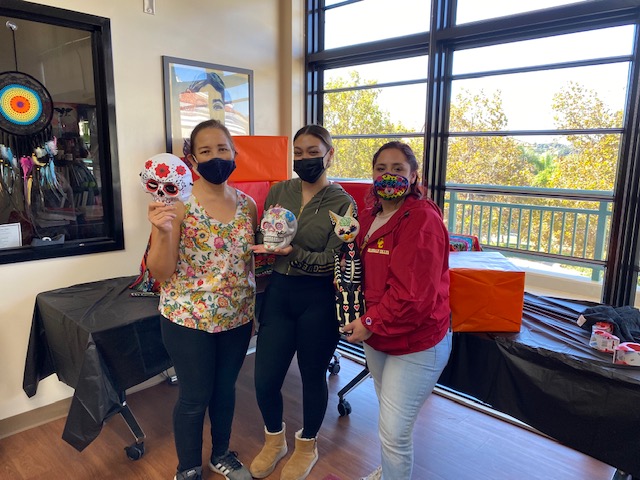
 Three students holding up sugar skulls in the Multicultural center

Photo Description: Three students holding up decorative skulls in preparation to build the altar.

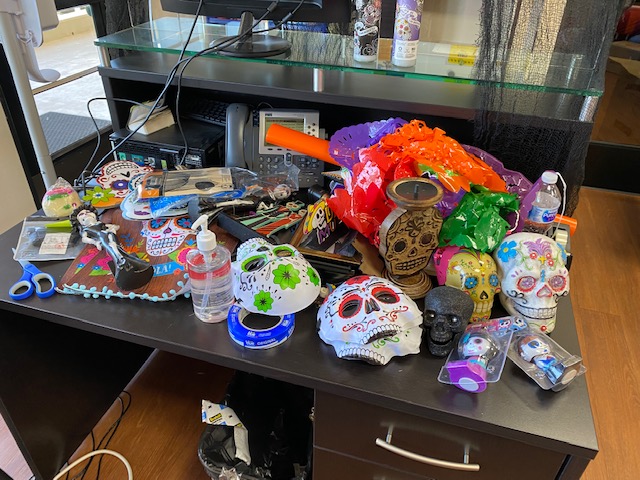
Table full of materials to build altar (skulls, marigolds, and other decorations)

Photo Description: Table filled with decorations such as sugar skulls, papel picado (perforated paper), as well as photos and favorite objects of loved ones who have passed on. (Can't forget the hand sanitizer!)

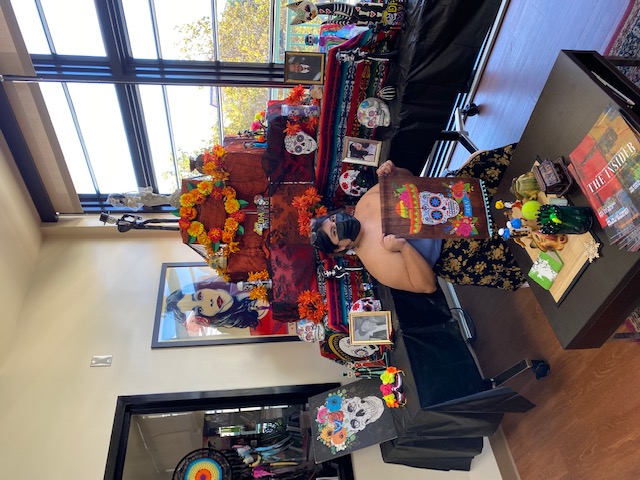
 Student holding up skull decoration in front of ofrenda (altar)

Photo Description: A La Comunidad student posing with a decorative banner in front of the completed ofrenda.

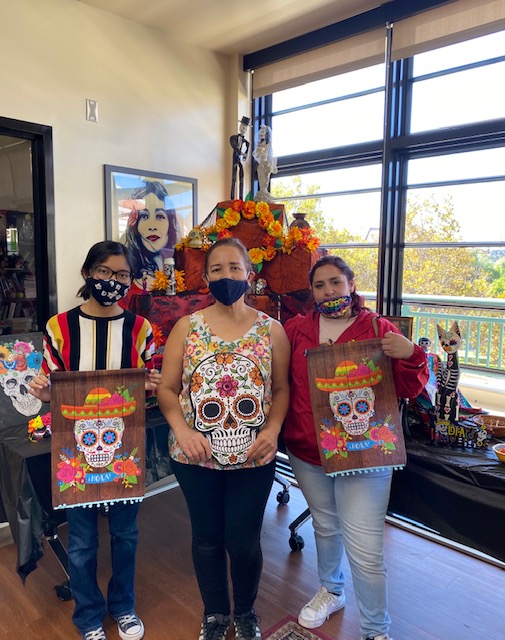
Three students posing in front of the altar holding sugar skull banners

Photo Description: Three students posing with sugar skull decorative pieces.

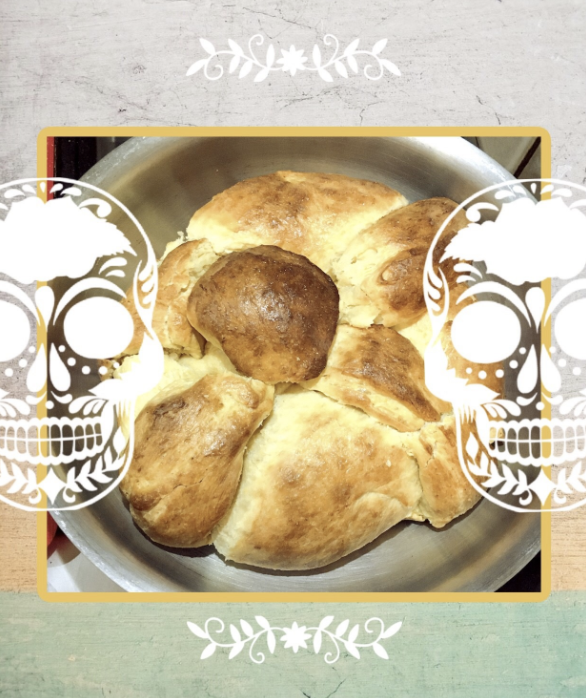
picture of pan de muerto with two white skulls on the left and right side.The Beauty of Pan de Muerto

Life has no end and no beginning - life is eternal. This idea is conveyed through pan de muerto, a staple baked good of the Mexican holiday known as Día de los Muertos (Day of the Dead). This traditional holiday takes place on November 1st and 2nd, and honors loved ones who have passed on. Ofrendas (altars) are built and picture frames of loved ones who have passed are placed upon them. In addition, the altars are decorated with vibrant cempasúchil (cempasuchitl in the Nahua language - the language of the Mexica) flowers, colorful sugar skulls, candles, foods and drinks, and more. On Día de los Muertos, the holiday is not only to honor passed loved ones, but it also defines the day these loved ones cross over to the world of the living. On this holiday, families gather in cemeteries and eat the favorite foods of those who have passed, celebrating the beauty of life.  

Origins of Pan de Muerto

Much of this holiday has its roots in the traditions of the Mexica in Mesoamerica. One of the staple foods of this holiday is pan de muerto, a food that traces back to the time of the Mexica. The Mexica made a bread-like sustenance that consisted of honey, amaranth, and seemingly human blood to serve as an offering to the gods. Once the Spanish conquered the area, however, they replaced amaranth with wheat flour and rather than using human blood, they decorated the bread with red-colored sugar to act as a symbol for the human blood. Thus, the modern pan de muerto was created. 

Pan de Muerto: Today

There are over 1,200 variations of pan de muerto, depending on each region of the countries that bake it. A classic design of pan de muerto is known as the hojaldra. This variation consists of a round shape, bone-like shaped bread that lies on and across the round bread, and a ball on top. The roundness of the bread symbolizes the circle of life, having no beginning and no end - eternal life. The bone-like bread creates a cross and symbolizes the bones and tears of loved ones who have passed away. In addition, they each point to four cardinal points, each representing a Mexica god - Tezcatlipoca, Xipe Tótec, Quetzalcóatl, and Tláloc. The ball represents, then, the skull of loved ones who have passed away.


This video recipe will recreate a variation of the pan de muerto, provided by Mely Martinez’s online blog Mexico in My Kitchen, and will consist of this classic design.

Ingredients Needed:

    • 500 grams 4 cups All Purpose flour

    • 2 Tablespoons active-dry yeast 

    • 100 grams sugar ½ cup 

    • 1 teaspoon salt 

    • 80 grams butter at room temperature + 30 grs. to brush the bread after baking. 

    • 80 grams unsalted margarine room temperature plus more for bowl and pans. 

    • 4 large eggs room temperature 

    • Orange zest from 2 oranges 

    • 60 ml. warm water about 110 degrees 

    • 1 teaspoon orange blossom water or orange essence 

    • 1 large egg lightly beaten to brush the bread 

    • Sugar to decorate the bread at the end

    Video created by Alicia Lambarri and edited by Katherine Juarez. Write up by Emily Torres.

    Please see the following YouTube video to learn how to make your own marigolds using basic materials at home!


    Smithsonian Latino Center

    • This is an interactive website created by Smithsonian Latino Center. There is a slide show and a series of videos.

    Traditions - Day of the Dead

    • This beautiful website made by Cereal Ventures is a wealth of information, with pages for History, Traditions, Mexican Culture, Designs, Sugar Skull, Recipes, and Events. There is also a shopping page for Day of the Dead items. Another charming feature of this website is a countdown clock to the next Dia de los Muertos.

    National Geographic

    • This website from National Geographic gives a general overview of Dia de los Muertos, with some colorful photographs. There are pages for Background Info, Questions, Fast Facts, and Vocabulary.

    • Dia de los muertos, face painting on 2019Archive

      Past Día de los Muertos Events