HISTORY AND BASIC KILN DESIGNS
The earliest kilns were certainly no more than the hearths used by primitive peoples
for cooking, warmth, light, and protection. In fact, very simple ‘pit’ kilns are still
in use today. Clay was used since prehistory to create figurines and representations
of animals and people, but the date of the actual discovery of the firing process
is unknown. However, the Neolithic period, when agriculture began, is generally cited
as the origin of fired clay objects, approximately 10,000 years ago. These early farmers
needed containers for seeds, for harvested foods to be stored, and for water transportation
and storage. Fired clay served these needs well, and was locally available and easy
to form. The earliest kilns were nothing more than a shallow PIT dug in the ground. Pottery was loose stacked on top of each other. Combustible materials
were placed around and above the pottery and the fire was allowed to burn down. After
cooling, the pots were cleaned of the ash and residue and were then used. Pots fired
in this way were very fragile and porous due to the low temperatures possible in such
a firing (1000°-1200° Fahrenheit). At this low temperature glazing is not possible
and was not discovered until much later. Advantages of this type of firing are its
relative ease of ‘construction’ and low cost. Disadvantages are the low temperature
limitations and the fragility of the ware. Also, many pieces break during the firing
process due to the erratic nature of the firing and poor insulation. Although the
‘pit’ kiln does not appear to be much of a kiln, it is nonetheless considered one.
What then, are the minimum requirements for a fuel burning kiln? They are:
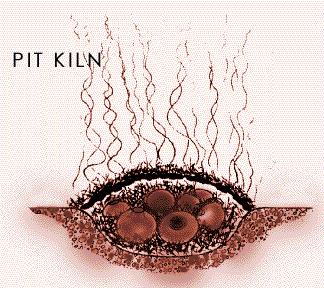 Refer to the illustration and notice that this kiln does have insulation-the earth
itself. Earth is a decent insulator, is not flammable, and is certainly abundant.
The loading area is, of course, the pit itself, the fuel is any flammable organic
material such as wood, straw, or manure, and the oxygen is available in the air surrounding
the kiln. So, basic as it is, this kiln meets the requirements. However, the design
defects of this kiln are quite obvious: primarily that the kiln is upside down! The
insulation should be on top, and the fuel should be on the bottom. The pit kiln looses
most of its heat out the top. Early potters tried putting the fuel at the bottom of
the firing, but found that as the fire burned down, the logs would fall, and so would
the pottery, breaking everything. So, for this reason, they had to put the fuel on
top. They had no architectural technology enabling them to construct an arch. With
the rise of settled agricultural communities, however, construction techniques improved
and better kilns were built.
Refer to the illustration and notice that this kiln does have insulation-the earth
itself. Earth is a decent insulator, is not flammable, and is certainly abundant.
The loading area is, of course, the pit itself, the fuel is any flammable organic
material such as wood, straw, or manure, and the oxygen is available in the air surrounding
the kiln. So, basic as it is, this kiln meets the requirements. However, the design
defects of this kiln are quite obvious: primarily that the kiln is upside down! The
insulation should be on top, and the fuel should be on the bottom. The pit kiln looses
most of its heat out the top. Early potters tried putting the fuel at the bottom of
the firing, but found that as the fire burned down, the logs would fall, and so would
the pottery, breaking everything. So, for this reason, they had to put the fuel on
top. They had no architectural technology enabling them to construct an arch. With
the rise of settled agricultural communities, however, construction techniques improved
and better kilns were built.
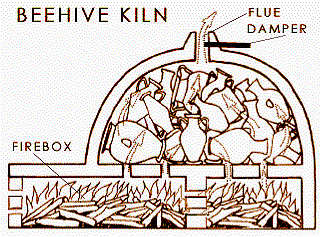 The BEEHIVE kiln was the first kiln constructed that looks like what we consider a kiln. See
the illustration at left, and notice that now the fuel and fire are below the ware,
the insulation, in the form of an arch is on top, retaining the heat better.The pots
are stacked within this chamber allowing greater retention of heat. The enclosing
of the kiln presents a problem. Oxygen access is restricted, and, without ventilation,
this kiln will not burn properly. Therefore, a hole at the top of the kiln, known
as a FLUE, must be included in the beehive design. The DAMPER is the device that regulates the size of the opening of the flue. Oxygen does not
enter the flue. Rather, it exits the flue by nature of the tendency of heat to rise.
As the fire burns, and the kiln gets hotter, the hot air rises and leaves the kiln
through the flue. Meanwhile, cool air enters the bottom at the FIREBOX. As the fire burns, the atmospheric oxygen in depleted in the combustion process,
so a steady supply of oxygenated air is required. This is provided by the draft of
air described above. Just as in a fireplace, the damper must be open, providing and
adequate supply of cool, oxygenated air to enter at the bottom. A kiln such as this
is called an UPDRAFT kiln. This basic design was so simple, effective, and logical
that it is the basic kiln design used all over the world to this day. The arch design
was necessitated by the fact that all other structures are less stable. Remember,
the kiln had to be able to stand without the use of ‘glues’ or mortars to hold the
bricks together. The nature of the arch could do this. This same arch design has been
used through the ages to support bridges, cathedral domes, aqueducts, and freeways.
Notice that although this kiln looks quite different from the pit kiln, it incorporates
the four essential requirements of a fuel-burning kiln listed above. Insulation is
still clay, but now in the form of clay bricks. With minor variations in design, this
kiln is the standard design used by potters around the world.
The BEEHIVE kiln was the first kiln constructed that looks like what we consider a kiln. See
the illustration at left, and notice that now the fuel and fire are below the ware,
the insulation, in the form of an arch is on top, retaining the heat better.The pots
are stacked within this chamber allowing greater retention of heat. The enclosing
of the kiln presents a problem. Oxygen access is restricted, and, without ventilation,
this kiln will not burn properly. Therefore, a hole at the top of the kiln, known
as a FLUE, must be included in the beehive design. The DAMPER is the device that regulates the size of the opening of the flue. Oxygen does not
enter the flue. Rather, it exits the flue by nature of the tendency of heat to rise.
As the fire burns, and the kiln gets hotter, the hot air rises and leaves the kiln
through the flue. Meanwhile, cool air enters the bottom at the FIREBOX. As the fire burns, the atmospheric oxygen in depleted in the combustion process,
so a steady supply of oxygenated air is required. This is provided by the draft of
air described above. Just as in a fireplace, the damper must be open, providing and
adequate supply of cool, oxygenated air to enter at the bottom. A kiln such as this
is called an UPDRAFT kiln. This basic design was so simple, effective, and logical
that it is the basic kiln design used all over the world to this day. The arch design
was necessitated by the fact that all other structures are less stable. Remember,
the kiln had to be able to stand without the use of ‘glues’ or mortars to hold the
bricks together. The nature of the arch could do this. This same arch design has been
used through the ages to support bridges, cathedral domes, aqueducts, and freeways.
Notice that although this kiln looks quite different from the pit kiln, it incorporates
the four essential requirements of a fuel-burning kiln listed above. Insulation is
still clay, but now in the form of clay bricks. With minor variations in design, this
kiln is the standard design used by potters around the world.
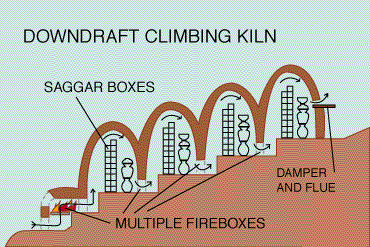 An interesting variation on the beehive design is the CLIMBING KILN, first built in China around 500 A. D. This design is also called a stepped or
hillside kiln. This kiln utilized the basic format of the beehive, but multiplied
the chambers so that total kiln capacity could be increased. This modification worked
well in villages where pottery making was the primary activity, and where a large
volume of pottery needed to be fired at once. Notice in the illustration how each
chamber has the arch construction typical of the beehive, but that the chambers are
joined so that the draft passes through from one chamber to the next. After the kiln
is loaded, the fire is lit in the bottom chamber’s firebox. The heat rises through
the first chamber, and rather than passing out the flue at the top of this chamber,
notice how the heat is cycled down and into the opening at the base of chamber number
two. After the first chamber has been fired to its ultimate temperature, the potters
begin stoking firewood into the firebox at the base of chamber two. The heat follows
the same circuitous path as before, rising, then falling, and entering the base of
chamber three. This process is continued until all chambers have reached temperature.
Notice that the draft of the kiln is eventually up, even though along the way it has
taken several downwards turns. Such a kiln is referred to as a DOWNDRAFT kiln, even though the ultimate draft is UP. It is the observation that the draft
is DOWN during part of the cycle that causes this kiln to be called a DOWNDRAFT. The
biggest disadvantage of this kiln design is that large quantities of pottery are required
to fill these huge kilns, making it an impractical design for the individual potter.
This is, of course, its big advantage also: large quantities of work can be processed
at once, making it ideal for pottery communities. As mentioned earlier, this kiln
was first built in China, probably to increase the volume of pottery available for
trade. However, a significant difference in these kilns is that they were able to
reach higher temperatures than any kilns before. The recycling of waste heat, the
increased thickness of the walls necessary to reinforce these huge chambers, and the
multiple fireboxes all combined to cause higher temperatures to result. It was in
such kilns that the earliest stoneware and porcelain were developed. Certainly not
on purpose initially, but over time the art of porcelain manufacture was perfected
by the Chinese potters and held secret for over 700 years. These kilns were huge,
often 10-12 chambers, and therefore difficult to conceal. Eventually neighboring villages
began to copy the design, and the concept spread out of China to Korea, Japan and
ultimately the West. However, by the time this idea traveled to the United States,
pottery villages were all but extinct, their role supplanted by machine-made pottery.
One additional interesting feature of this kiln is the use of SAGGAR boxes, which were used to protect the pottery from flying wood ash. These saggar
boxes, which were made of clay, are indicated in the diagram as the square boxes stacked
in each of the chambers. Without these protective boxes the pottery would have been
subject to attack by the wood ash, which at these higher temperatures would form glaze
and stick pieces together.
An interesting variation on the beehive design is the CLIMBING KILN, first built in China around 500 A. D. This design is also called a stepped or
hillside kiln. This kiln utilized the basic format of the beehive, but multiplied
the chambers so that total kiln capacity could be increased. This modification worked
well in villages where pottery making was the primary activity, and where a large
volume of pottery needed to be fired at once. Notice in the illustration how each
chamber has the arch construction typical of the beehive, but that the chambers are
joined so that the draft passes through from one chamber to the next. After the kiln
is loaded, the fire is lit in the bottom chamber’s firebox. The heat rises through
the first chamber, and rather than passing out the flue at the top of this chamber,
notice how the heat is cycled down and into the opening at the base of chamber number
two. After the first chamber has been fired to its ultimate temperature, the potters
begin stoking firewood into the firebox at the base of chamber two. The heat follows
the same circuitous path as before, rising, then falling, and entering the base of
chamber three. This process is continued until all chambers have reached temperature.
Notice that the draft of the kiln is eventually up, even though along the way it has
taken several downwards turns. Such a kiln is referred to as a DOWNDRAFT kiln, even though the ultimate draft is UP. It is the observation that the draft
is DOWN during part of the cycle that causes this kiln to be called a DOWNDRAFT. The
biggest disadvantage of this kiln design is that large quantities of pottery are required
to fill these huge kilns, making it an impractical design for the individual potter.
This is, of course, its big advantage also: large quantities of work can be processed
at once, making it ideal for pottery communities. As mentioned earlier, this kiln
was first built in China, probably to increase the volume of pottery available for
trade. However, a significant difference in these kilns is that they were able to
reach higher temperatures than any kilns before. The recycling of waste heat, the
increased thickness of the walls necessary to reinforce these huge chambers, and the
multiple fireboxes all combined to cause higher temperatures to result. It was in
such kilns that the earliest stoneware and porcelain were developed. Certainly not
on purpose initially, but over time the art of porcelain manufacture was perfected
by the Chinese potters and held secret for over 700 years. These kilns were huge,
often 10-12 chambers, and therefore difficult to conceal. Eventually neighboring villages
began to copy the design, and the concept spread out of China to Korea, Japan and
ultimately the West. However, by the time this idea traveled to the United States,
pottery villages were all but extinct, their role supplanted by machine-made pottery.
One additional interesting feature of this kiln is the use of SAGGAR boxes, which were used to protect the pottery from flying wood ash. These saggar
boxes, which were made of clay, are indicated in the diagram as the square boxes stacked
in each of the chambers. Without these protective boxes the pottery would have been
subject to attack by the wood ash, which at these higher temperatures would form glaze
and stick pieces together.
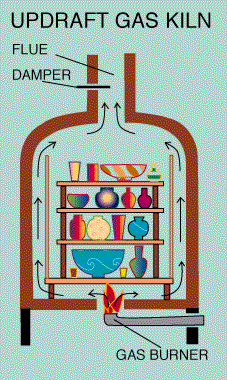
The most common kiln design utilized by contemporary potters is the natural gas UPDRAFT kiln. The illustration shows how very similar this kiln design is to the BEEHIVE
kiln. Basically, it is the same in all respects. Rather than using firewood, natural
gas is the fuel. We now have better quality insulating brick, but otherwise nothing
has really changed. Note that the damper and flue are in the same places and have
the same function.
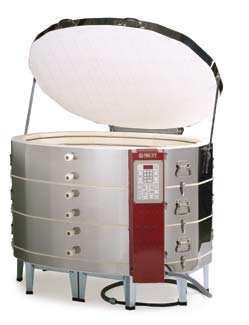 ELECTRIC KILNS
The electric kiln is the only really new kiln technology of the 20th century. Instead
of a burning fuel, these operate by radiant heat generated from an electrical current
passing through coiled wires. A toaster operates on the same principle. Since these
kilns have no fireboxes and no burning inside, they have no need of a damper or flue,
since no draft in necessary. Thus electric kilns have no hole at top. They are neither
updraft or downdraft, more like NO DRAFT kilns. What they share with the fuel-burning
kilns is insulation and a loading area, but not a fuel or a need for an oxygen draft.
FIRING DIFFERENCES: ELECTRIC/FUEL
These two types of kilns give quite different results in firing. Remember that fuel-burning
kilns require oxygen; electric kilns do not. A fuel-burning kiln(fired with its damper
open, providing the kiln with adequate draft) will fire with results identical to
an electric kiln. However, partially closing the damper during the firing process
will have a dramatic effect on glaze colors. Here’s how: A FUEL is a material that
can combine with OXYGEN to create a fire in a process called COMBUSTION. Generally, the fuel takes the oxygen from the atmosphere during the firing. If the
damper is partially closed however, the draft is reduced, providing the fuel with
not enough oxygen to combust completely. The fuel will then try (chemically) to ‘find’
the oxygen it ‘needs’ from any other source in the kiln. What other sources are there?
The clay and glaze materials contain oxygen in the form of the metallic oxides such
as silicon dioxide, cobalt oxide, iron oxide, copper oxide, etc. A chemical reaction
takes place such as:

Note that the original form of iron oxide contains two atoms of iron to every 3 of
oxygen. During the firing process, the fuel has reduced two oxygen atoms from the
iron, leaving us with a new form of iron oxide, in which the ration is 1:1. The only
reason we care about any of this as potters, is that these two forms of iron are different
colors. This process results in forms of the metallic oxides that are REDUCED in oxygen.
We have come to call this chemical process REDUCTION, and this firing process, REDUCTION FIRING. In an electric kiln, in contrast, there is no draft, no oxygen demand, and no damper.
Thus closing it is impossible; it does not exist. So, therefore, reduction firing
is impossible in an electric kiln unless the kiln itself is on fire! Firings in which
the oxygen levels in the oxides are not reduced are termed OXIDATION FIRINGS, referring to the observation that the oxygen is not changed. Colors are thus more
predictable in an electric kiln (this is good and bad). To summarize, a fuel-burning
kiln is capable of REDUCTION or OXIDATION depending of the damper position. An electric
kiln is capable of only OXIDATION.
PYROMETERS AND PYROMETRIC CONES
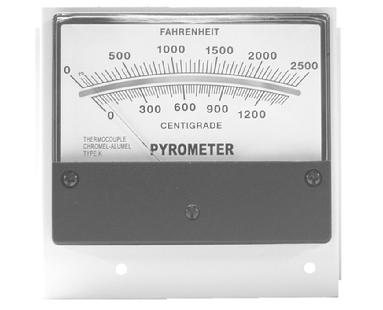 ANALOG PYROMETER
Regardless of what type of kiln is used, the potter needs to be able to accurately
determine the temperature inside the kiln. For this we use the pyrometer and pyrometric cones. A pyrometer is an analog or digital instrument used to measure heat at high temperatures.
The analog version (at left) consists of a calibrated dial connected to wires which
protrude into the kiln. When heated, the welded junction of these wires produces a
small electrical current which registers as a temperature reading on an indicator
dial. While simple to use, the pyrometer is, unfortunately, not very accurate. It
does provide a reasonable guide to whether the temperature in the kiln is rising smoothly
and consistently, but does not provide an accurate enough reading to determine the
end point of the firing. For this, pyrometric cones are used.
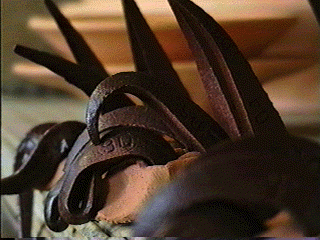 Pyrometric cones are commercial produced ‘pyramids’ of molded glaze, predetermined
to melt at specific temperatures. Cones are available at approximately 40° intervals.
So the potter puts 3-4 cones in the kiln, arranged in a sequence of increasing melting
temperature, so that when the melting temperature of the first cone is reached, it
begins to melt, and bend so that by looking through the spy hole in the kiln, this
can be seen. This provides a warning to the potter that the kiln is nearing its maturing
temperature, and is called the warning cone. About 15-30 minutes later, the second cone’s melting point will have been reached,
and it begins to bend also. This process continues until the desired temperature has
been reached, and the target cone bends. The potter usually places one additional cone in the group, the melting temperature
of which is higher than that desired. This cone should remain standing, indicating
that the desired temperature has not been exceeded. This is referred to as the guard cone. Cones are more accurate than a pyrometer since they are made of glaze, just like
the glazes on the surfaces of the pottery. So, when the cones melt, one can be assured
that the glazes are melting also. Usually, a potter will use both a pyrometer and
cones, since each provides information at different phases of the firing process.
The pyrometer tells the potter what is happening early in the process, and during
the cool down phase. The cones tell what is happening at the exact point of glaze
melting.
Pyrometric cones are commercial produced ‘pyramids’ of molded glaze, predetermined
to melt at specific temperatures. Cones are available at approximately 40° intervals.
So the potter puts 3-4 cones in the kiln, arranged in a sequence of increasing melting
temperature, so that when the melting temperature of the first cone is reached, it
begins to melt, and bend so that by looking through the spy hole in the kiln, this
can be seen. This provides a warning to the potter that the kiln is nearing its maturing
temperature, and is called the warning cone. About 15-30 minutes later, the second cone’s melting point will have been reached,
and it begins to bend also. This process continues until the desired temperature has
been reached, and the target cone bends. The potter usually places one additional cone in the group, the melting temperature
of which is higher than that desired. This cone should remain standing, indicating
that the desired temperature has not been exceeded. This is referred to as the guard cone. Cones are more accurate than a pyrometer since they are made of glaze, just like
the glazes on the surfaces of the pottery. So, when the cones melt, one can be assured
that the glazes are melting also. Usually, a potter will use both a pyrometer and
cones, since each provides information at different phases of the firing process.
The pyrometer tells the potter what is happening early in the process, and during
the cool down phase. The cones tell what is happening at the exact point of glaze
melting.
Some kilns come equipped with an automatic kiln sitter, which is a device that uses the melting of the cones to automatically shut down
the kiln. While convenient, these devices should never be relied upon 100% because
they have been known to fail. There is no substitution for the vigilance of the potter
during these crucial firing decisions.
*Please note that this is not a primer on how to load and fire a kiln, only a brief and selective history of kiln design. Before you attempt to load and
fire any kiln, you should be trained by an experienced person. In the more advanced
classes here at GCC, students learn how to load and fire both gas and electric kilns.
Firing a kiln without proper instruction is very dangerous and may result in damage
to the kiln, injuries to yourself and others, and damage to adjacent property.
GO TO TOP OF PAGE